

Dan Robbins: The Man Who Invented Paint by Numbers
If you walk into most craft stores today and you'll probably find paint-by-number kits depicting everything from landscapes to famous works of art. If you look online you can even create customizable paint by numbers to recreate a pet or family photo.
The idea feels so familiar now that it's easy to forget someone had to invent it. That person was Dan Robbins.
Robbins was a commercial artist working for a Detroit paint company when he helped develop a deceptively simple idea: break a painting into outlined sections, assign each section a number and match those numbers to specific paint colors.
The concept turned painting a canvas into something anyone could do vs. "a real artist".
What started as an experiment at a small paint company became one of the biggest cultural crazes of the 1950s. Millions of kits were sold, critics debated whether they could possibly be considered art, and finished paint-by-number paintings appeared in thousands of homes across America. More than 70 years later, art enthusiasts of every skill level are still painting by the numbers.
Who Was Dan Robbins?
Dan Robbins, born John Daniel Robbins, was an American commercial artist best known for developing the paint-by-number system that became a phenomenon during the 1950s.
Robbins was born in Detroit, Michigan, on May 26, 1925. He attended Cass Technical High School, where he developed his artistic abilities, before serving as a mapmaker in the U.S. Army during World War II.
After completing his service, he returned to Detroit and eventually found work with the Palmer Paint Company.
The Palmer Paint Company and Max Klein
Palmer Paint was owned by Max S. Klein, an entrepreneur looking for new ways to sell paint.
Robbins initially worked on children's products, but Klein requested he focus on projects that could get adults painting into painting.
The years following World War II saw major changes in American life. As the country's economy expanded, many Americans found themselves with more disposable income and leisure time. Hobbies and do-it-yourself projects became increasingly popular.
Klein's directions Robbbins were clear: capitalize on that trend. Robbins was tasked with creating a product that could make painting accessible to someone who wasn't an artist.
Did Leonardo da Vinci Inspire Paint by Numbers?
Yes, as a boy Robbins had heard a story where Da Vinci would provide apprentices with numbered sections of a painting that corresponded to particular colors.
This became the genesis of the idea for Robbins wondered whether a similar system could work for amateur painters. Instead of asking someone to stare at a blank canvas (incredibly daunting for beginners) providing them with a clear structure could make the painting process much easier and more enjoyable.
The painter would still physically create the image. But the difficult decisions involving composition, shapes and color selection would already have been made. Each area of the canvas could simply contain a number. Match the number to the corresponding paint color, fill in the section and gradually the image would emerge. It was effectively a coloring book with paint.
The Smithsonian credits the modern paint-by-number concept to both Robbins and Klein, dating its conception to 1949.
So while Robbins is commonly called the inventor of paint by numbers, the more complete story is that the system emerged from the partnership between an artist trying to solve the creative problem and a businessman searching for a product people would buy.
The First Paint-by-Number Painting
Coming up with the concept was one thing but putting it into large scale production was a completely separate problem.
Robbins' first attempt wasn't a quaint landscape, a horse or a bowl of flowers. Instead, he created an abstract painting divided into numbered sections.
He called it Abstract No. 1.
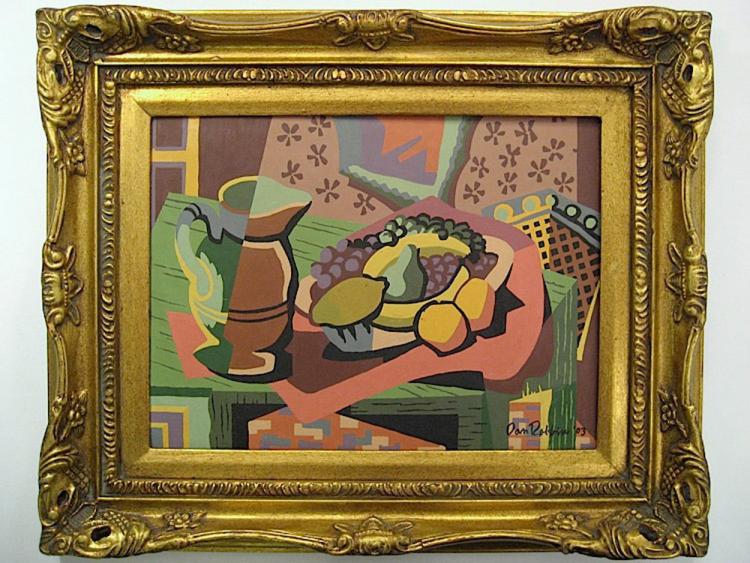
The design demonstrated that the system worked: follow the numbers and a complete painting emerged. The only problem was that Max Klein didn't like it.
Klein understood that proving the concept wasn't enough. If paint by numbers was going to become a successful product, people needed to actually want the painting hanging on their wall when they finished.
Robbins began creating more conventional subjects with broader appeal like landscapes, animals and scenic views. The basic system remained the same, but the end result became something a hobbyist could proudly frame and display.
That shift helped lead to the product that would eventually become known across America.
Craft Master Paint-by-Number Kits Are Born
Palmer Paint introduced the kits under the name Craft Master. Robbins created the initial six Craft Master paint-by-number kits in 1951. Each kit contained the essential ingredients needed to turn someone with little or no painting experience into a painter.
A picture was divided into outlined areas. Each area contained a number corresponding to one of the included paint colors. The painter worked through the image section by section until the outlines and numbers disappeared beneath the paint.
From a customer's perspective, the concept was wonderfully simple. Behind the scenes, it wasn't.
Creating a paint-by-number design required artists to take a completed image and determine how it could be reconstructed by an amateur using a limited palette.
Shapes had to be simplified without destroying the image. Colors had to be selected carefully. Outlines, overlays and numbered sections had to correspond correctly. Finished designs had to be painted and tested before they could be sold.
The Smithsonian's archives describe a production process involving artists who helped create outlines, transparent overlays, paintings, printing materials and proofs.
Even Robbins' and Klein's wives helped paint sample designs used for testing and displays.
What looked like a shortcut to painting actually required a considerable amount of artistic and technical work to create.
At First, Paint by Numbers Wasn't an Immediate Hit
When Craft Master originally launched paint by numbers kits, it was not an immediate hit.
The concept was unfamiliar, and there was early on friction with convincing customers to paint a predetermined image themselves rather than simply buy a finished picture.
Getting over this mental blocker required advertising. Craft Master began appearing in major department stores, including Macy's, and the company found a message that perfectly captured the appeal of the product:
"Every Man a Rembrandt!"
It was an ambitious promise. You didn't need years of art lessons. You didn't need to know color theory. You didn't even need to know how to draw. If you could match a paint color to a number, Craft Master offered the possibility of creating something that looked like a real painting. Over time, thousands of Americans embraced the message.
The Paint-by-Number Craze Takes Over America
By 1954, Palmer Paint had sold approximately 12 million paint-by-number sets, according to the Detroit Historical Society.
What had begun as a way to sell more paint had become one of the top diy crafts in the country.
Craft Master expanded far beyond Robbins' original six designs. Subjects included landscapes, seascapes, animals and religious scenes, along with recreations inspired by famous works of art.
One of the most notable artists in Craft Masters' expansion was Adam Grant, an accomplished artist and Holocaust survivor whom Robbins later regarded as one of the company's most talented artists. Grant designed Craft Master's version of Leonardo da Vinci's The Last Supper, which became one of the company's most popular designs.
The scale of the business eventually became extraordinary.
By the middle of the decade, Craft Master employed hundreds of people, with dozens of artists working on new designs daily and production reaching tens of thousands of kits per day. Naturally, this led to competitors popping up.
Why Were Paint-by-Number Kits So Popular?
The paint by numbers appeal was obvious, not only was it fun, but it also a great piece of art to hang up in your home.
A beginner facing a blank canvas has to decide what to paint, how to draw it, which colors to use, how to mix those colors and how to apply them. Failure is visible immediately.
Paint by numbers removed virtually all of those barriers.
Instead of asking, Can I paint this?, the painter only had to ask, Which color goes here?
After dozens or hundreds of small decisions, the painter could step away from the canvas and see a finished image.
Paint by numbers wasn't necessarily intended to transform everyone into a professional artist. It allowed people who might otherwise never pick up a brush to experience the satisfaction of painting something themselves.
That distinction became important, because not everyone was happy about the craze.
Paint by Numbers Becomes Part of American Culture
The hobby grew so popular that paint-by-number paintings became an instantly recognizable part of 1950s American life. The completed pieces were often hung in living rooms, bedrooms and family spaces.
Not only could people paint them alone, but it was also something you could do with family members.
Famous Americans painted by numbers too.
Works connected to figures including Nelson Rockefeller and J. Edgar Hoover would later appear in the Smithsonian's examination of the craze.
The concept even crossed into the world of fine art that had once mocked it.
In the early 1960s, Andy Warhol created works based on the paint-by-number idea, including his Do It Yourself series.
Something originally dismissed for making art too mechanical had itself become a recognizable symbol artists could reference.
What Happened to the Original Paint-by-Number Craze?
Like most crazes, paint by numbers eventually cooled.
Competition became intense as other manufacturers entered the market. The novelty faded, and American consumers moved on to other hobbies.
But Craft Master didn't simply disappear at its peak.
The business had become significant enough to operate as a separate company, and Klein eventually sold Craft Master in 1959. The brand subsequently passed through several owners.
The extraordinary cultural moment of the early 1950s was over.
Paint by numbers, however, continued to have a niche following. Paint by number kits continued to be manufactured and sold long after the original craze subsided.
That longevity ultimately became one of the most remarkable parts of Robbins' invention.
What Did Dan Robbins Do After Paint by Numbers?
Robbins' career wasn't limited to the product that made him famous.
He continued working as an artist and designer and eventually reflected extensively on the phenomenon he had helped create.
His story also became increasingly interesting to museums and cultural historians as the 1950s receded into history.
What critics had once dismissed as a cheap commercial hobby began to look like a fascinating artifact of postwar American culture.
Robbins eventually wrote about his experience in a memoir appropriately titled Whatever Happened to Paint-by-Numbers?
The Smithsonian Revisits Paint by Numbers
In 2001, half a century after Craft Master appeared, the Smithsonian's National Museum of American History opened an exhibition called Paint by Number: Accounting for Taste in the 1950s.
The exhibition ran from April 2001 through January 2002.
Rather than treating the kits simply as old craft supplies, the Smithsonian examined what the craze revealed about American culture.
Millions of people had enthusiastically embraced paint by numbers while elite critics had ridiculed them.
That divide raised larger questions.
Who gets to decide what counts as art?
Does art need to be original to be meaningful?
Is following a predetermined design inherently less creative?
Does it matter if the person making it enjoys the experience?
The Smithsonian described the phenomenon as a "fault line between elite and popular culture."
That may be the most interesting part of the paint-by-number story.
The kits weren't important because critics eventually decided they were masterpieces.
They were important because millions of people didn't need critics' permission to enjoy them.
The Death of Dan Robbins
Dan Robbins died on April 1, 2019, in Sylvania, Ohio.
He was 93 years old.
His death generated national attention, with obituaries recognizing him as the man who helped bring painting into millions of American homes.
It was an unusual legacy for someone who had originally been given the relatively straightforward assignment of finding another way for a paint company to sell paint.
Robbins had spent much of his career as a commercial artist rather than a celebrated fine artist.
Yet very few 20th-century artists can claim to have gotten as many people to actually pick up a paintbrush.
Dan Robbins' Legacy
More than seven decades after Robbins began experimenting with numbered sections, the fundamental paint-by-number experience has barely changed.
There is still an outlined image.
There are still numbered sections.
There are still corresponding paints.
And there is still that slightly strange moment halfway through a painting when the canvas looks like a mixture of finished artwork and unexplained shapes.
Then the sections begin coming together.
Eventually, you step back and see the image instead of the numbers.
What has changed is what can become a paint-by-number design.
Robbins and the Craft Master artists had to create individual paintings that could be reproduced as kits for thousands of customers. Modern image processing and printing have made it possible to take the same basic idea and apply it to an individual's photograph.
A wedding photo, a picture of a childhood home, a favorite vacation or a photo of a pet can now become the starting point for a custom paint-by-number kit.
That's a technological evolution Robbins couldn't have had access to in 1951, but the underlying idea is remarkably similar to his original one.
Take an image that looks difficult to paint.
Break it into manageable sections.
Pick up a brush.
Start with a number.
A Simple Idea That Lasted
There are plenty of products that sell millions of units and then disappear. Paint by numbers did something different. Its original 1950s moment came and went, but the activity survived. Children and adults alike still craft with paint by numbers.
Old Craft Master kits have become collectibles. Museums preserve the history of the craze. Artists still debate where guided painting fits within the broader definition of art.
And new generations continue discovering the same experience Robbins wanted to make possible in the first place.
You don't have to know how to create a painting from scratch to enjoy creating one.
For an idea born inside a Detroit paint company more than 70 years ago, that's a remarkable legacy.


